



Modern elevators are expected to do much more than simply move passengers between floors. Building owners and passengers increasingly expect elevators to operate quickly, smoothly, quietly, safely, and efficiently. One of the most important technologies responsible for achieving these requirements is the elevator drive.
An elevator drive controls the speed, acceleration, deceleration, and movement of the elevator motor. By precisely controlling the motor’s electrical power, an elevator drive helps the system start smoothly, travel at the required speed, and stop accurately at each floor.
Whether used in residential buildings, commercial complexes, hospitals, hotels, or high-rise towers, a properly selected elevator drive system can significantly influence overall elevator performance.
In this guide, we explain how elevator drives work, how they improve speed and efficiency, and why they are essential for achieving better ride comfort in modern elevator systems.
What Is an Elevator Drive?
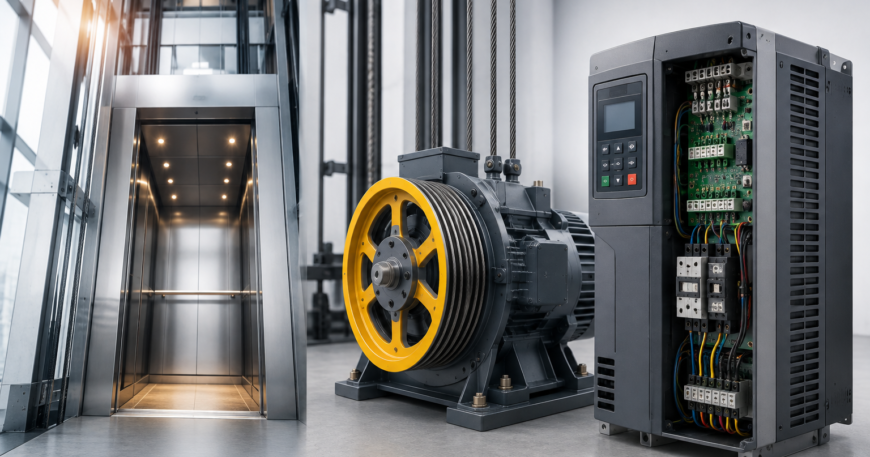
An elevator drive is an electronic device used to control the operation of an elevator motor. It regulates the electrical power supplied to the motor and adjusts motor speed according to the elevator controller’s commands.
Modern elevator drives commonly use Variable Frequency Drive (VFD) technology. A VFD can control the frequency and voltage supplied to the motor, allowing precise control over motor speed and torque.
The elevator controller communicates with the drive to determine how the motor should operate. The drive then provides the appropriate electrical output to achieve the required acceleration, travel speed, and deceleration.
In simple terms, the elevator controller decides what the elevator needs to do, while the drive helps control how the motor performs that movement.
How Do Elevator Drives Work?
The working process of an elevator drive involves several coordinated stages.
1. Receiving Commands
The elevator controller sends commands to the drive based on passenger calls, elevator position, door status, safety signals, and programmed operating parameters.
The drive receives information about the desired direction and movement of the elevator.
2. Controlling Motor Speed
The drive regulates the electrical frequency and voltage supplied to the motor.
Instead of simply switching the motor on or off, the drive can gradually increase or decrease motor speed.
This provides much better control over elevator movement.
3. Managing Acceleration
When an elevator starts moving, the drive gradually increases motor output according to the programmed acceleration profile.
Controlled acceleration reduces sudden movement and helps passengers experience a smoother start.
4. Maintaining Travel Speed
During the main portion of the journey, the drive maintains the required motor speed.
The exact speed depends on the elevator design, building height, motor specifications, load, and programmed control parameters.
5. Controlled Deceleration
As the elevator approaches the destination floor, the drive gradually reduces motor speed.
This controlled deceleration is important for maintaining passenger comfort and achieving accurate floor stopping.
How Elevator Drives Improve Elevator Speed
Elevator speed is not simply about making the motor rotate faster. The entire movement profile must be carefully controlled.
A modern elevator drive system allows the motor to accelerate efficiently, maintain the required travel speed, and decelerate at the appropriate time.
Faster Acceleration
A properly configured drive can provide controlled acceleration without creating excessive jerking or sudden movement.
This allows the elevator to reach its target travel speed efficiently.
Optimized Travel Speed
The drive can maintain a consistent motor speed during the main travel phase.
For high-speed elevators, accurate motor control becomes particularly important because even small changes in speed can affect ride quality.
Precise Deceleration
The drive begins reducing motor speed as the elevator approaches its destination.
This helps the elevator transition smoothly from high-speed travel to precise floor leveling.
How Elevator Drives Improve Energy Efficiency
Energy efficiency is another major advantage of modern elevator drives.
Traditional motor control methods can provide limited control over motor speed. Modern VFD-based systems can adjust motor operation according to the elevator’s actual requirements.
Variable Speed Control
Instead of operating the motor at a fixed speed, a variable frequency drive adjusts motor speed according to the movement profile.
This can reduce unnecessary energy use during acceleration, travel, and deceleration.
Optimized Motor Operation
Modern drives can help operate the motor closer to its required operating conditions.
This is particularly valuable in buildings where elevators operate frequently throughout the day.
Regenerative Technology
Some advanced elevator drive systems can incorporate regenerative braking technology.
During certain operating conditions, the elevator motor can act as a generator. Depending on the system design, energy generated during braking can be returned to the building’s electrical system or managed through an appropriate energy-management arrangement.
Regenerative systems can therefore help reduce energy losses in suitable high-traffic elevator applications.
How Elevator Drives Improve Ride Comfort
Passenger comfort is one of the most noticeable benefits of a well-designed elevator drive system.
Passengers may not see the drive inside the control system, but they can immediately notice the quality of the elevator’s movement.
Smooth Starting
A properly programmed drive gradually increases motor torque when the elevator begins moving.
This reduces sudden acceleration and provides a smoother start.
Controlled Acceleration
The acceleration profile can be adjusted according to the elevator’s design.
A carefully configured acceleration curve can reduce uncomfortable changes in movement.
Smooth Deceleration
The drive gradually reduces speed as the elevator approaches the destination.
This helps create a comfortable transition from travel speed to stopping.
Accurate Floor Leveling
Precise motor control helps the elevator approach the floor accurately.
Good coordination between the drive, controller, position feedback system, and motor allows the elevator to stop at the correct position.
Elevator Drives and Gearless Elevator Systems
Elevator drives play an important role in both geared and gearless elevator applications.
Gearless elevator systems commonly use high-efficiency traction motors and can benefit from advanced drive technology for precise speed and torque control.
Gearless systems are often selected for high-rise and high-performance applications where smooth movement, efficiency, and speed are important.
The drive must be properly matched with the motor and elevator controller to achieve the desired performance.
Elevator Drives and Geared Elevator Systems
Geared elevators use a motor connected through a gearbox to the traction system.
Modern drives can also provide precise speed and torque control for geared elevator machines.
The drive helps control acceleration, travel speed, and deceleration while working with the elevator controller and other electrical components.
For many low- and mid-rise applications, a properly designed geared elevator combined with an appropriate drive and control system can provide reliable and comfortable performance.
Key Benefits of Modern Elevator Drives
A properly selected and configured elevator drive can provide several advantages:
- Smooth acceleration and deceleration
- Better ride comfort
- Accurate floor leveling
- Controlled motor speed
- Improved energy efficiency
- Reduced mechanical stress
- Better motor control
- Reliable elevator operation
- Support for high-speed applications
- Potential regenerative energy savings
- Improved overall system performance
The actual benefits depend on the motor, drive, controller, elevator configuration, operating conditions, and installation quality.
Important Features to Consider When Choosing an Elevator Drive
Selecting an elevator drive requires careful consideration of the complete elevator system.
Motor Compatibility
The drive should be properly matched with the elevator motor’s voltage, current, power, speed, and control requirements.
Load Capacity
The elevator’s rated load and operating conditions influence the required motor and drive specifications.
Travel Speed
Higher-speed applications require a drive capable of providing precise motor control across the required speed range.
Control Method
Modern drives may support different motor-control techniques depending on the motor and application.
Feedback System
Encoder or other position-feedback systems can provide the controller and drive with information required for precise motor control.
Safety and Protection
The drive should provide appropriate monitoring and protection features as part of the overall elevator control architecture.
Energy Efficiency
For high-use elevators, energy consumption should be considered when selecting the motor and drive technology.
The Role of Elevator Control Panels
An elevator drive does not operate independently. It works as part of a complete elevator control system.
The elevator control panel receives signals from buttons, sensors, safety circuits, door systems, and position devices. It processes these signals and communicates movement commands to the drive.
The drive then controls the motor according to those commands.
This coordination between the elevator control panel, elevator drive, motor, sensors, and safety systems is essential for reliable elevator operation.
A well-engineered control panel should therefore be designed around the selected drive and motor rather than treating each component as an isolated system.
Maintenance of Elevator Drive Systems
Regular inspection and maintenance are important for maintaining elevator drive performance.
Maintenance teams should follow the equipment manufacturer’s recommendations and applicable elevator maintenance requirements.
Important areas can include:
- Electrical connections
- Cooling and ventilation
- Drive fault history
- Motor connections
- Encoder and feedback systems
- Control-panel wiring
- Drive parameters
- Protective devices
- Signs of overheating or abnormal operation
Any maintenance or adjustment of elevator equipment should be performed by appropriately qualified professionals.
Why the Right Elevator Drive Matters
The elevator drive has a direct influence on how an elevator starts, accelerates, travels, slows down, and stops.
A poorly matched or incorrectly configured drive can negatively affect performance, while a properly selected and commissioned drive can help deliver smooth, efficient, and reliable operation.
For this reason, elevator manufacturers, contractors, and building owners should consider the motor, drive, controller, safety system, and mechanical components as one complete system.
Conclusion
Elevator drives are a critical component of modern elevator systems. They provide precise control over motor speed, torque, acceleration, and deceleration, helping elevators achieve better speed, efficiency, and passenger comfort.
Modern VFD-based elevator drives can optimize motor operation, provide smoother movement, improve floor leveling, and support advanced features such as regenerative energy management in suitable applications.
Whether an elevator uses a geared or gearless traction machine, the right drive and control configuration can make a significant difference in overall system performance.
At Windsor Controls, reliable elevator control solutions can be engineered to integrate elevator drives, control panels, motors, safety circuits, and other electrical components into a coordinated system. With the right combination of technology and engineering, modern elevators can deliver the smooth, efficient, and dependable performance expected in today’s buildings.