



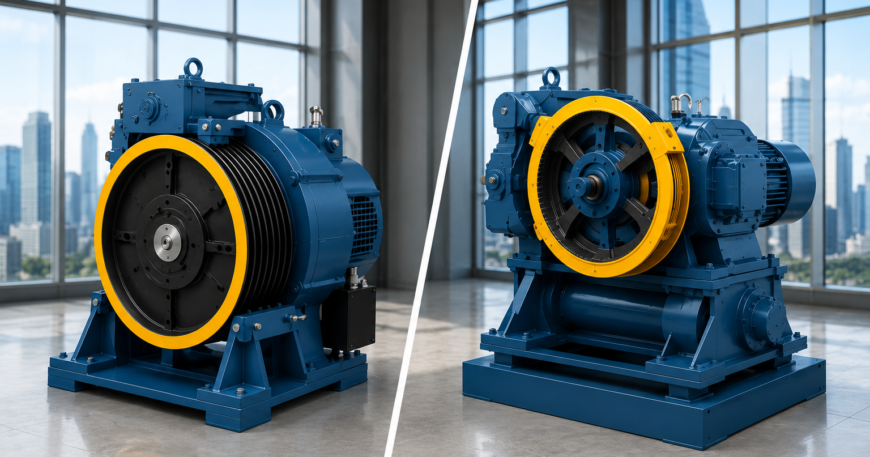
Choosing the right elevator system is an important decision for any residential, commercial, industrial, or high-rise building project. Elevator performance depends on several factors, including building height, traffic requirements, speed, energy efficiency, available machine-room space, maintenance requirements, and overall project budget.
Two of the most widely used traction elevator technologies are geared elevators and gearless elevators. While both systems use an electric motor, traction sheave, ropes, and counterweight to move the elevator, their machine and drive configurations are different.
Understanding the difference between gearless vs. geared elevator systems can help architects, builders, elevator contractors, and project owners select a solution that matches their specific requirements.
What Is a Geared Elevator System?
A geared elevator system uses an electric motor connected to a gearbox. The gearbox reduces the motor’s high rotational speed and transfers the required torque to the traction sheave.
The traction sheave moves the elevator ropes, which raise or lower the elevator car and counterweight.
Because the gearbox provides mechanical speed reduction, the motor can operate at a higher speed while the traction system operates at a suitable speed for the elevator.
Geared elevator systems have been widely used for many years and remain suitable for numerous low- and mid-rise applications.
Key Features of Geared Elevators
Some common characteristics of geared elevator systems include:
- Electric motor with gearbox
- Suitable for many low- and mid-rise buildings
- Moderate elevator speeds
- Proven and widely used technology
- Flexible application options
- Generally suitable for buildings with moderate traffic
- Requires appropriate machine-room equipment
The exact configuration and performance depend on the elevator design, motor, controller, drive, load capacity, and other components.
What Is a Gearless Elevator System?
A gearless elevator system uses a motor that drives the traction sheave directly, without a gearbox between the motor and sheave.
Modern gearless elevators commonly use permanent-magnet or other high-efficiency traction machines, depending on the system design.
Because there is no gearbox, the motor can directly provide the torque needed to move the traction sheave. This makes gearless technology particularly suitable for applications requiring higher speeds, efficient operation, and smooth performance.
Gearless traction systems are commonly associated with high-rise buildings, commercial properties, and applications where high performance is important.
Key Features of Gearless Elevators
Typical characteristics include:
- Direct-drive traction machine
- No traditional gearbox
- Suitable for higher-speed applications
- High efficiency potential
- Smooth acceleration and deceleration
- Compact machine configurations available
- Suitable for high-rise and high-traffic applications
- Advanced drive and control systems
The actual performance of a gearless elevator depends on the machine, drive, controller, elevator design, and operating conditions.
Gearless vs. Geared Elevator: Key Differences
Although both systems use traction technology, their mechanical configurations create several important differences.
1. Motor and Drive Mechanism
The primary difference is the way the motor connects to the traction sheave.
In a geared elevator, the motor drives a gearbox, which then drives the traction sheave.
In a gearless elevator, the motor directly drives the traction sheave.
This difference affects the mechanical design, efficiency, speed capabilities, and maintenance requirements of the elevator system.
2. Elevator Speed
Geared elevators are commonly used for moderate-speed applications. They can provide reliable performance in many low- and mid-rise buildings.
Gearless systems are generally better suited to higher-speed elevator applications and are frequently selected for taller buildings where faster travel is required.
However, the appropriate speed should always be determined by the complete elevator design rather than by machine type alone.
3. Energy Efficiency
Energy efficiency is an increasingly important consideration in modern buildings.
Gearless traction machines can offer high efficiency because they eliminate the mechanical losses associated with a traditional gearbox. Modern permanent-magnet gearless machines can also provide efficient operation when combined with an appropriate drive and control system.
Geared elevators can still provide efficient operation, particularly when paired with modern variable frequency drives and properly designed control systems.
Actual energy consumption depends on factors such as elevator capacity, travel height, traffic patterns, motor technology, drive configuration, standby behavior, and building usage.
4. Maintenance Requirements
Geared elevator systems contain additional mechanical components because of the gearbox. Gearboxes require appropriate inspection, lubrication, and maintenance.
Gearless systems eliminate the traditional gearbox, which can reduce certain mechanical maintenance requirements.
However, gearless elevators still require regular inspection and maintenance of their motors, brakes, bearings, ropes, traction components, electrical systems, and controls.
Therefore, neither system should be considered maintenance-free.
5. Machine-Room Requirements
Traditional geared and gearless systems can have different machine-room requirements depending on the elevator configuration.
Modern gearless machines can be designed in compact configurations and may be suitable for machine-room-less or other space-efficient elevator arrangements.
The available building space should therefore be considered during the early planning stage.
6. Initial Project Cost
The initial cost of an elevator system depends on much more than whether it is geared or gearless.
Motor technology, elevator capacity, speed, controller, drive, cabin design, doors, safety systems, installation requirements, and building configuration can all affect the overall project cost.
Gearless systems may have a higher initial equipment cost in some applications, but their efficiency and performance can make them attractive for buildings with demanding operational requirements.
Advantages of Geared Elevator Systems
Geared elevators continue to be a practical solution for many projects.
Cost-Effective for Suitable Applications
For moderate-speed and low- to mid-rise buildings, geared systems can provide an effective balance between performance and project requirements.
Proven Technology
Geared traction technology has been used extensively in elevator installations, giving contractors and maintenance teams broad experience with the system.
Suitable for Moderate Traffic
Many commercial and residential buildings with moderate elevator usage can operate effectively with geared systems.
Flexible Configuration
Geared systems can be configured for different capacities and building requirements when properly engineered.
Advantages of Gearless Elevator Systems
Gearless technology offers several advantages for demanding elevator applications.
High-Speed Performance
Gearless traction machines are well suited to higher-speed elevator systems, making them a popular choice for tall buildings.
Efficient Operation
The direct-drive design eliminates traditional gearbox losses and can provide high operating efficiency.
Smooth Ride Quality
When combined with a suitable elevator control system and variable frequency drive, gearless machines can provide precise acceleration, deceleration, and stopping.
Reduced Gearbox Maintenance
Because there is no traditional gearbox, maintenance associated specifically with gearbox lubrication and wear is eliminated.
Suitable for High-Rise Buildings
Gearless elevators are frequently selected for high-rise and high-traffic applications where speed, efficiency, and performance are important.
How Elevator Control Panels Affect Both Systems
Regardless of whether an elevator uses a geared or gearless machine, the control system plays an essential role in overall performance.
The elevator control panel receives signals from the elevator cabin, landing buttons, sensors, safety circuits, and other components. It processes these signals and communicates with the motor drive and other elevator equipment.
A Variable Frequency Drive (VFD) can control motor speed, acceleration, and deceleration. Proper coordination between the controller and drive helps provide smooth movement and accurate floor leveling.
For this reason, selecting a suitable elevator control panel and drive system is just as important as selecting the appropriate traction machine.
Which Elevator System Is Right for Your Project?
There is no single answer for every building. The right choice depends on the project’s specific requirements.
Choose a Geared System When:
A geared elevator may be appropriate when:
- The building is low- or mid-rise
- Moderate elevator speed is sufficient
- Traffic requirements are moderate
- A proven traction solution is preferred
- Project requirements favor a conventional configuration
- The application does not require the higher-speed capabilities of a gearless machine
Choose a Gearless System When:
A gearless elevator may be more suitable when:
- The building is high-rise
- Higher elevator speeds are required
- Passenger traffic is high
- Energy efficiency is a major consideration
- Smooth and precise performance is important
- Reduced gearbox-related maintenance is desirable
- A modern direct-drive traction solution is preferred
Other Factors to Consider Before Choosing
Before making a final decision, project owners and elevator professionals should evaluate more than just the machine type.
Important considerations include:
Building Height: Taller buildings may benefit from the speed and performance capabilities of gearless systems.
Traffic Requirements: Buildings with heavy passenger traffic may require a high-performance elevator configuration.
Capacity: Elevator load capacity affects machine selection, motor requirements, ropes, and other components.
Travel Speed: Required speed should be determined based on building height, traffic, and passenger requirements.
Energy Consumption: Consider both running and standby energy consumption.
Maintenance: Evaluate the availability of qualified technicians and long-term maintenance requirements.
Available Space: Machine-room and shaft-space limitations can influence equipment selection.
Budget: Consider both initial investment and long-term operating and maintenance costs.
Final Thoughts
The decision between a gearless and geared elevator system depends on the building, application, performance requirements, budget, and long-term operating goals.
Geared elevators remain a reliable and practical option for many low- and mid-rise applications where moderate speed and proven technology are sufficient. Gearless elevators, on the other hand, are often preferred for high-rise and high-performance applications because of their direct-drive configuration, efficiency potential, smooth operation, and higher-speed capabilities.
The elevator machine is only one part of a complete elevator system. The controller, VFD, safety system, door operator, wiring harness, sensors, and other electrical components must work together to achieve reliable performance.
At Windsor Controls, properly engineered elevator control solutions can help integrate the electrical and automation requirements of both geared and gearless elevator systems. Selecting the right combination of elevator machine, control panel, drive, and electrical components can help create a dependable, efficient, and comfortable elevator solution for modern buildings.
Before selecting a system, it is recommended to evaluate the complete project requirements with qualified elevator professionals and select equipment according to the applicable design and safety requirements.